
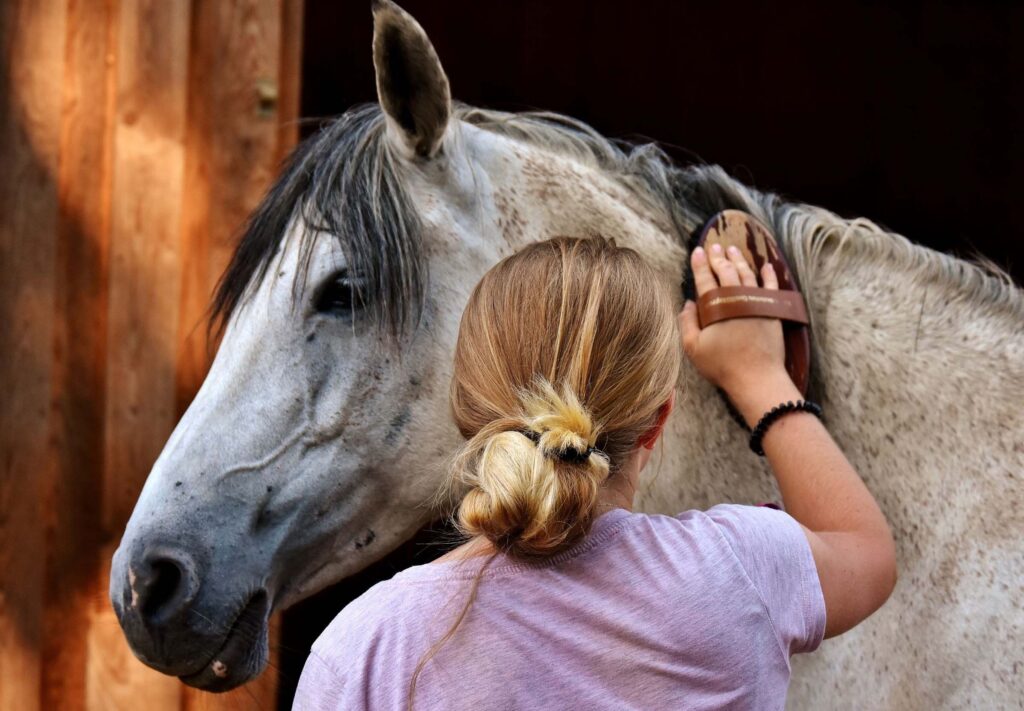
At Performance Equine Nutrition, we often hear from owners who are doing everything they can for a horse that still does not feel right. They have called the vet. They have treated the obvious problems. They have changed feed, changed hay, adjusted management, questioned the saddle, and tried to listen to every signal their horse is giving them.
And still, the horse keeps saying, “Something is wrong.”
This was the case for “Megan” and her 16-year-old Quarter Horse gelding, “Trigger.”
Note: Names have been changed to protect client confidentiality.
The Beginning: A Horse Under Stress
Megan started working with Trigger in September 2025. Soon after, Trigger moved to a boarding facility where he was going long stretches without food and was only being fed twice a day. For a horse with a sensitive system, that kind of routine can become a major stressor.
Trigger eventually developed ulcers and was treated. At first, he improved. That made sense. The most obvious source of pain had been addressed, and for a while, things seemed to be moving in the right direction.
But by Christmas break, during a stretch of brutally cold weather, the behavior started creeping back in. Trigger began biting at his sides again.
Megan changed the hay program. He was put on an alfalfa-grass mix, grass hay in the evening, and Timothy cubes. She kept trying to support his gut and comfort. But by February 2026, the side-biting had gotten worse, and the vet was called again.
Ulcers Were Real, But They Weren’t the Whole Story
Trigger was treated again for ulcers with omeprazole and sucralfate. Megan saw some improvement at first, but the symptoms never fully went away.
In April 2026, Trigger was scoped and was positive for glandular ulcers. That diagnosis mattered. Ulcers are painful, and they absolutely deserve veterinary care. Trigger was not “making it up,” and Megan was right to keep digging.
But even with treatment, Trigger’s presentation was complicated. He had also been diagnosed with a sway back and likely needed a new saddle. When lunging, he bit at his right side. He began bucking in the round pen. Some days he was better. Then the biting would come back again.
That pattern, better, then worse, then better, then worse, is what so many owners describe as “consistently inconsistent.”
When the Symptoms Start Spreading
Over time, Trigger’s symptoms were no longer limited to side-biting.
He began pawing while standing in the pasture and at the gate. He would paw with his right leg, kick at his belly, and twitch through his side. He became grumpy about brushing. He started acting miserable in the stall, pacing so much that he was tearing it up. He became difficult for the farrier behind. Bathing, something he used to enjoy, became a problem.
Then came the moment that shook Megan: Trigger tried to bite her and eventually bit her hard on the arm.
This was not the horse she knew.
Trigger is a 15.1 hand, roughly 1,000-pound Quarter Horse gelding and a barrel horse. He is not a delicate horse, and he is not a horse who has never had a job. But his nervous system looked like it was living at the edge. Windy weather made things worse. One day, he ran himself ragged, ripping around like he could not settle in his own body.
Megan described him as a “10 out of 10.”
And honestly, that is exactly the kind of case that breaks your heart. Because when a horse becomes that reactive, painful, defensive, and unpredictable, it is easy for the world to label him as dangerous or bad.
But often, what we are really seeing is a horse in distress.
Looking at the Full Pattern
Trigger’s case is important because several things were going on.
He had a history of feed-management stress. He had confirmed ulcers. He had body and saddle concerns. He was a barrel horse with a performance workload. He had a five-year history of headshaking. He had trailering stress. He had reactive behavior, body sensitivity, twitching, side-biting, belly-kicking, stall-walking, farrier issues, and a sudden increase in defensive behavior.
When we look as part of the magnesium question, we are not saying, “This is only magnesium.” We are saying, “This is a horse whose full pattern may be worth evaluating for magnesium shortfall alongside continued veterinary care.”
Magnesium plays an important role in muscle relaxation, nervous system regulation, stress tolerance, and recovery. Horses under physical and mental stress can use magnesium more quickly. When a horse is already dealing with pain, ulcers, hauling stress, weather stress, workload, and body soreness, his ability to cope can become smaller and smaller.
That is when owners may start seeing the horse unravel in multiple places at once.
The “Consistently Inconsistent” Clue
One of the biggest clues in Trigger’s story is the inconsistency.
He improved with ulcer treatment, but not completely. He stopped biting his sides, then started again. He could seem manageable one moment and explosive the next. He could be okay, then suddenly pawing, kicking at his belly, twitching, biting, pacing, or reacting to wind like his nervous system had no brakes.
That one-day-better, one-day-worse pattern is something many magnesium-shortfall horses seem to show. Not every horse presents the same way. Some show more mental signs: anxiety, spooking, overreactivity, hauling issues, or inability to settle. Others show more physical signs: tight muscles, body soreness, twitching, resistance to grooming, difficulty with the farrier, or reduced tolerance for work.
Many show both.
Why Ulcer Horses Can Be So Complicated
Ulcers and magnesium shortfall can be difficult to sort apart because both can affect behavior.
A horse with ulcers may bite at his sides, resent grooming, react to the leg, become girthy, lose focus, or act defensive. A horse with magnesium shortfall may also be tense, reactive, sore, twitchy, spooky, inconsistent, and difficult to handle. When both patterns are present, the owner can feel like she is chasing symptoms from one corner of the barn to the other.
This is why Trigger’s veterinary care mattered so much. Scoping confirmed glandular ulcers, and those needed treatment. But his broader pattern suggested that gut support alone might not address the entire picture.
For horses like Trigger, the question becomes: “What else does this horse need in order to feel safe, comfortable, and regulated again?”
What Horse Owners Can Watch For
Trigger’s story is a reminder that behavior is communication.
Side-biting, belly-kicking, pawing, stall-walking, biting, bucking, brushing sensitivity, hauling issues, and farrier problems are not random annoyances. They are pieces of a larger conversation. The horse may be telling us he is painful, overwhelmed, depleted, or unable to recover from stress.
That does not mean every horse with these signs is magnesium deficient. It does mean the pattern is worth looking at carefully, especially when the horse is also under workload, dealing with ulcers, showing muscle tension or twitching, and becoming increasingly inconsistent.
At Performance Equine Nutrition, this is why we ask questions. We want to understand the full picture: diet, workload, stress history, ulcer history, body soreness, behavior, recovery, and management. The goal is not to replace veterinary care. The goal is to support the horse from every appropriate angle so he has the best chance to feel better mentally and physically.
If your horse sounds like Trigger, reactive, sore, inconsistent, sensitive to touch, difficult to settle, and not fully improving even after addressing obvious medical concerns, magnesium support may be worth considering as part of the larger picture.
Because sometimes the horse is not being bad.
Sometimes he is trying, in every way he knows how, to tell us he cannot cope anymore.
Need Help Looking at Your Horse’s Pattern?
If your horse is showing signs of tension, soreness, spookiness, inconsistent behavior, poor recovery, or stress-related changes, we are happy to help you think through the full picture.
Take the Magnesium Deficiency Questionnaire or schedule a consultation with Performance Equine Nutrition.